
Description
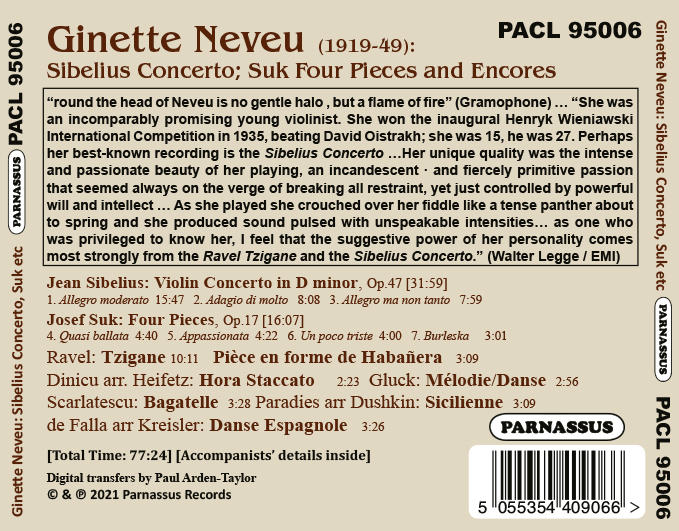
| Jean Sibelius: Violin Concerto in D minor, Op.47 |
| 1. Allegro moderato 15:47 |
| 2. Adagio di molto 8:08 |
| 3. Allegro ma non tanto 7:59 |
| Josef Suk: Four Pieces, Op.17 |
| 4. Quasi ballata 4:40 |
| 5. Appassionata 4:22 |
| 6. Un poco triste 4:00 |
| 7. Burleska 3:01 |
| 8. Ravel: Tzigane 10:11 |
| 9. Ravel: Pièce en forme de habañera 3:09 |
| 10. Dinicu arr Heifetz: Hora Staccato 2:23 |
| 11. Gluck: Mélodie/Danse (Orfeo ed Euridice) 2:56 |
| 12. Scarlatescu: Bagatelle 3:28 |
| 13. Paradies arr Dushkin: Sicilienne 3:09 |
|
14. de Falla arr Kreisler: Danse Espagnole 3:26 |
1-3: Philharmonia Orchestra / Walter Susskind (rec. London 1945)
4-10, 12, 14: Jean Neveu, piano (rec. London 1946)
11, 13: Bruno Seidler-Winkler, piano (rec. Berlin 1938)
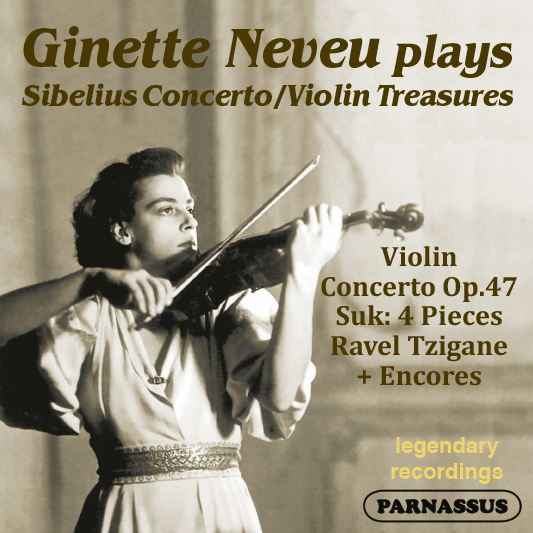
“around the head of Neveu is no gentle halo , but a flame of fire” (Gramophone) … “She was an incomparably promising young violinist. She won the inaugural Henryk Wieniawski International Competition in 1935, beating David Oistrakh; she was 15, he was 27. Perhaps her best-known recording is the Sibelius Concerto …Her unique quality was the intense and passionate beauty of her playing, an incandescent · and fiercely primitive passion that seemed always on the verge of breaking all restraint, yet just controlled by powerful will and intellect … As she played she crouched over her fiddle like a tense panther about to spring and she produced sound pulsed with unspeakable intensities… as one who was privileged to know her, I feel that the suggestive power of her personality comes most strongly from the Ravel Tzigane and the Sibelius Concerto.” (Walter Legge / EMI)